
A gentle stretch for the muscles at the back of the neck and the top of the shoulder. It can be done sitting or standing, so it is easy to fit in during the day.
Please note. These are examples of exercises we commonly prescribe. They are not a prescription: your chiropractor chooses the exercises, repetitions and frequency to suit you. Stop and tell us if an exercise causes sharp pain, dizziness, or pins and needles.
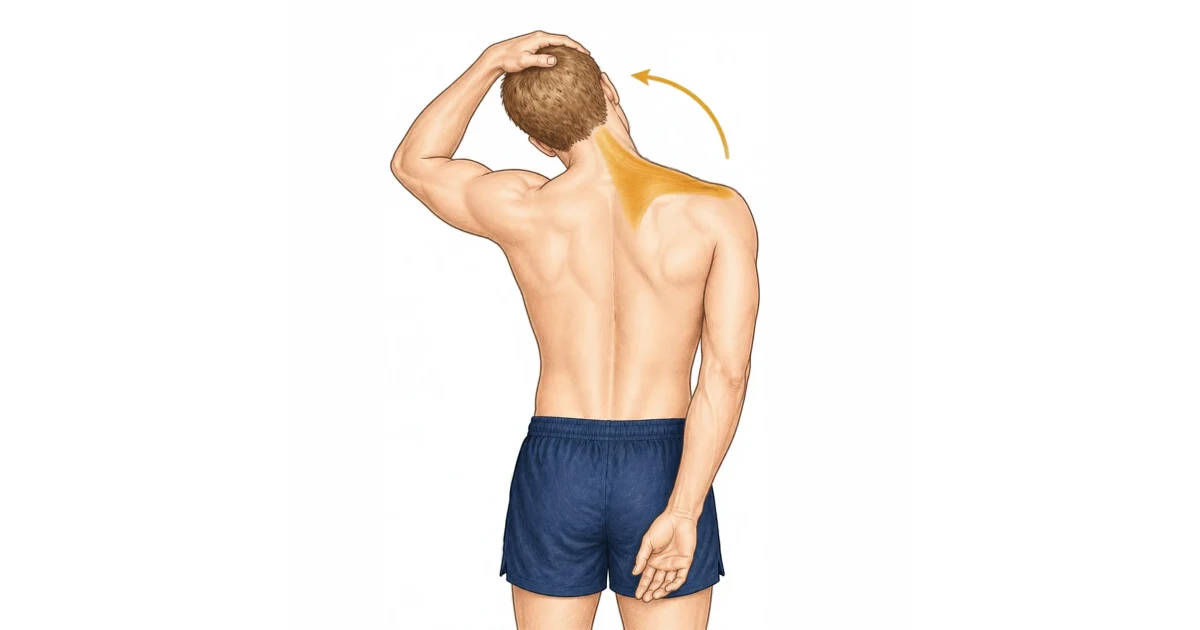
How to do it
- Sit or stand tall with your shoulders relaxed.
- Turn your head about halfway away from the side you want to stretch, so that you are looking towards the armpit on the other side. For example, to stretch the left side, turn towards your right armpit.
- Gently tuck your chin down and let your face move towards that armpit.
- Place the hand on that side on top of your head. Let its weight, with a very light pull, guide your head a little further forward and down.
- You should feel the stretch from the base of your skull down into your shoulder on the side you are stretching. Hold for 20 to 30 seconds, breathing normally, then release slowly and repeat on the other side if you need to.
How much
Hold the stretch for 20 to 30 seconds. If both sides are affected, stretch both sides.
What to watch for
- The stretch should feel gentle, not intense: around a 3 or 4 out of 10. Our article on what stretching actually does for pain explains why a gentle hold works better than a hard pull.
- Use only a light pull with your hand. Never pull or force your head, and keep the shoulder on the stretching side relaxed and down, away from your ear.
- Stop and tell us if you get sharp pain, pins and needles, numbness or tingling in your arm or hand, or dizziness.
- Avoid stretching if your neck pain started after an injury or fall, or comes with weakness or numbness. Have it assessed first.
Related conditions
- Neck pain and stiffness
- Headaches and migraine with a neck component
- Posture-related pain from desk work
More exercises
- Chin tuck (deep neck flexor activation)
- Thoracic rotation ("open book")
- Glute bridge
- Hip hinge
- Cat-camel
- Bird dog
- Seated figure 4 stretch
Your chiropractor will tell you which exercises suit you and how often to do them. Read our guide to self-care between appointments for general advice.